PDF Download Course of Theoretical Physics, Volume 2, Volume 2, Fourth Edition: The Classical Theory of Fields
Well, in relation to this issue, what type of book do you need now? This Course Of Theoretical Physics, Volume 2, Volume 2, Fourth Edition: The Classical Theory Of Fields It's truly wow! We are also having the collection of this publication soft data right here. It is not kind of thing by coincidence. This is the result of your effort to always follow just what we offer. By locating the book in this website it shows that we always provide the books that you really need so much.
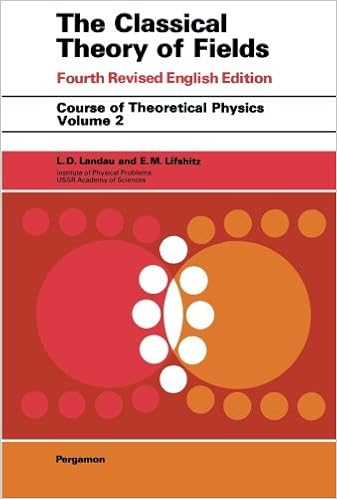
Course of Theoretical Physics, Volume 2, Volume 2, Fourth Edition: The Classical Theory of Fields

PDF Download Course of Theoretical Physics, Volume 2, Volume 2, Fourth Edition: The Classical Theory of Fields
After for some times, publications constantly become one selection to get the resource, the reliable and also legitimate resources. The topics concerning company, management, national politics, law, as well as lots of other subjects are readily available. Several authors from around the globe constantly make guide to be updated. The research, experience, understanding, and also inspirations always come once to others. It will confirm that book is timeless as well as perfect.
Reading is not for other individuals who obligate or order you to read. The one that could enjoy and make use of the advantages of reading is you. So, it is not kind of worse when you are aiming to be better by reading. Also analysis will certainly not lead you to be effective 100%; this way could assist you to satisfy the condition, lesson, experience, and also understanding. Additionally, this publication entitled Course Of Theoretical Physics, Volume 2, Volume 2, Fourth Edition: The Classical Theory Of Fields additionally becomes one that is really popular.
Well, also this publication is offered in different with the printed book; it will not be big issue. You understand why this website has many followers? Well, all provided books feature the soft documents. It is supplied based upon the title. When you look at the internet site in this web page, locating the connect to get this Course Of Theoretical Physics, Volume 2, Volume 2, Fourth Edition: The Classical Theory Of Fields is easy. Simply follow it and also discover the book.
Due to the fact that publication Course Of Theoretical Physics, Volume 2, Volume 2, Fourth Edition: The Classical Theory Of Fields has terrific benefits to review, lots of people now expand to have reading routine. Sustained by the established technology, nowadays, it is easy to obtain guide Course Of Theoretical Physics, Volume 2, Volume 2, Fourth Edition: The Classical Theory Of Fields Also the e-book is not existed yet in the marketplace, you to hunt for in this internet site. As what you could find of this Course Of Theoretical Physics, Volume 2, Volume 2, Fourth Edition: The Classical Theory Of Fields It will really relieve you to be the very first one reading this book Course Of Theoretical Physics, Volume 2, Volume 2, Fourth Edition: The Classical Theory Of Fields as well as get the advantages.
Review
The clarity of style, the conciseness of treatment and the originality and variety of illustrative problems make this a book which can be highly recommended.Proceedings of the Physical Society
Read more
Product details
Series: COURSE OF THEORETICAL PHYSICS (Book 2)
Paperback: 416 pages
Publisher: Pergamon; 4 edition (January 15, 1980)
Language: English
ISBN-10: 0080250726
ISBN-13: 978-0080250724
Product Dimensions:
6.8 x 0.9 x 10 inches
Shipping Weight: 1.8 pounds (View shipping rates and policies)
Average Customer Review:
4.3 out of 5 stars
43 customer reviews
Amazon Best Sellers Rank:
#205,782 in Books (See Top 100 in Books)
One of the greatest physics texts ever written. Landau immediately jumps into the water with clear descriptions of Einstein's principle of relativity and proceeds from there into momentum, plane waves, diffraction and the rest of modern theory. You cannot find a clearer, easier to read or more principle-driven elaboration of modern physics and fields.
I have read the old version in French which was very concise and the new one is even more concise.Landau & Lipchitz do not need recommendation as I think they are the best books I know of. I recommend the book of Field Theory to those who already are knowledgeable and who would like to add a high level overview on the field theory (including Relativity).This overview goes in parallel with a deep insight on the various aspects of the theory.(I also very strongly recommend Vol1 : Classical Mechanics of the same authors)
Landau's approach to Classical Field Theory demonstrates his ability to be clear, concise, and elegant without drowning out the physics with math. I will say, however, that Landau requires a certain maturity to appreciate his style (same goes for Rudin's books of analysis). I would recommend this title to those with a working knowledge of classical E & M, vector/tensor analysis, and of special relativity. It is also wise to work through the author's Theoretical Mechanics to get a taste of their style. I believe, contrary to many, that this book is appropriate for self study if one is willing to do the work (not only the exercises but following along pencil in hand). I suggest reading a passage and then covering it up and then trying to do the derivations by hand. My only complaint is the quality of print, which has is not the fault of the authors. It is especially annoying at first.
It's so simple to read and just to the point. I honestly had to use the Jackson book, which was not that great, but made a great grade because of the Landau-Lifshitz classic. Then there was the advanced MIT EM book which made so much more sense, but it was all math. Those 3 books alone will give you a pretty adequate understanding of EM, enough to make over 95 out of 100 on every assignment. The Landau, MIT book together are well pretty cool themselves.
Very useful reference. Order sent promptly and the book was as described. I would definitely buy from this seller again.
This is a great upper-level E&M book. Every problem in the book has at least a partial solution to get you started and many have complete solutions. It's a great resource for studying E&M as well as general field theory.
Landau was a master: Concise, insightful, and capable of prodding the student's intellect to solve problems for oneself.As this text elucidates, Electrodynamics cannot be properly understood without the uber-principle of Relativity as foundation; and that is just the beginning.I am still fascinated and a little exhilarated every time I am reminded of the Gauge Invariance associated with the Electrodynamic field. Landau broaches this subject near the very beginning of the text (Paragraph 18) in an elegant way. Because the definitions of the Magnetic field (B) and Electric field (E) contain only the DERIVATIVES of the corresponding potentials rather than the potentials themselves (A, and phi, respectively), it's easily proven that adding constants to the potentials will not affect the field intensities (remember the derivative of a constant = zero!).Here's the MathExample: E Field only:E = -1/c (dA/dt) - grad(phi)But if we change A and phi by adding constants to them, i.e.:A' = A + grad(f)phi' = phi - 1/c(df/dt)Thus, the new field E' = -1/c (dA'/dt) - grad (phi')or, expanding:E' = -1/c (dA/dt) - 1/c (d/dt grad(f)) - grad (phi) + 1/c grad (df/dt)The second and fourth terms on the right cancel, so E' = -1/c (dA/dt) - grad (phi) = E.The field intensity is unchanged despite changing the potentials.Same result obtains when considering the Magnetic field B = curl AAnother bombshell is that no matter how one is moving, the total Electrodynamic field does not change. Relative motion will change the measured intensity of the magnetic component B, or perhaps the electric component E depending on how one is moving, but there will always be a resultant compensating change in the one component when there is a change in the other, such that the full field remains unchanged. This represents the essential truth that the Electrodynamic field is a TENSOR, whose physical character is not affected by relative motion; it is invariant in any reference frame.Consider the profound ramifications bound in that concept: A light wave whose existence begins on the surface of some star, potentially traverses 6 or 7 reference frames before it is absorbed in some planets' atmosphere, or perhaps within a leaf. If a measurement is performed on that light wave within any of those reference frames, that measurement will betray the character of said reference frame; so in a sense, perhaps the electromagnetic (electrodynamic!) wave serves as a UNIVERSAL FRAME OF REFERENCE: TRULY INERTIAL.Mirror image of that statement is that if one could rather travel with the wave, as Einstein envisioned, one would "see" the rest of the universe without time, and thus without the effect of MOTION as one traversed these many different reference frames (galaxy, solar system, planetary orbit, rotating planet, etc).An analogous result obtains when considering even mechanical motion and time: Motion through space (x,y,z, or r, theta, phi, or x1, x2, x3) sacrifices motion through time (ct, or x4) such that the interval through space-time (x1, x2, x3, x4) is always unchanged; invariant. This is how the measurement of time becomes relative. Motion through time is contracted to compensate for the motion through space, keeping the interval invariant.Both the Electrodynamic Field and the Gravitational Field are Gauge Fields.Another principle that bent my brain Landau covers in paragraph 95: The equations of the gravitational field also contain the equations for the matter which produces said field.From which the central conclusions may be deduced.Matter is FieldField and matter do not really fill space, like we all intuitively think. Rather, empty space has no objective measurable reality.As Einstein put it: "There is no space empty of field"Thus: Field..... is..... Space
Arrived as described
Course of Theoretical Physics, Volume 2, Volume 2, Fourth Edition: The Classical Theory of Fields PDF
Course of Theoretical Physics, Volume 2, Volume 2, Fourth Edition: The Classical Theory of Fields EPub
Course of Theoretical Physics, Volume 2, Volume 2, Fourth Edition: The Classical Theory of Fields Doc
Course of Theoretical Physics, Volume 2, Volume 2, Fourth Edition: The Classical Theory of Fields iBooks
Course of Theoretical Physics, Volume 2, Volume 2, Fourth Edition: The Classical Theory of Fields rtf
Course of Theoretical Physics, Volume 2, Volume 2, Fourth Edition: The Classical Theory of Fields Mobipocket
Course of Theoretical Physics, Volume 2, Volume 2, Fourth Edition: The Classical Theory of Fields Kindle

Tidak ada komentar :
Posting Komentar